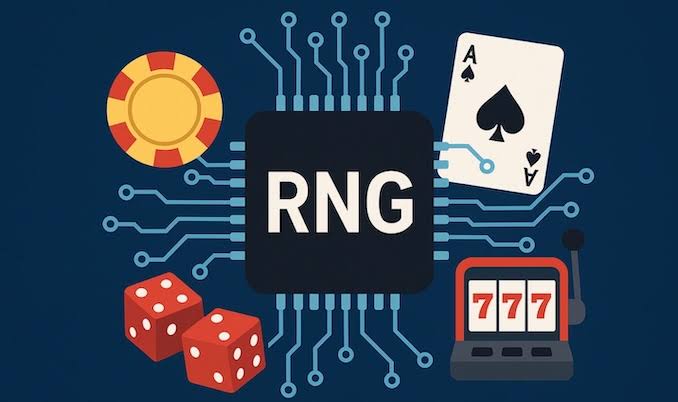
This educational guide explains how Random Number Generators (RNGs) work in online casino games, including pseudorandom number generation, fairness testing, independent audits, game outcomes, RTP, volatility, and responsible gambling. The article is intended for educational purposes and does not guarantee winning results or predict future outcomes.
Online casino games rely heavily on technology. Behind every spin, card draw, or digital game outcome is a complex system designed to generate results according to predefined game rules.
One of the most important technologies in this process is the Random Number Generator, commonly known as an RNG.
Understanding how RNGs work can help Indian players better understand online casino game mechanics and why previous results do not determine future outcomes.
What Is a Random Number Generator?
A Random Number Generator is a system designed to produce a sequence of numerical results.
In online casino games, these results are used to determine outcomes such as:
- Slot symbols.
- Card values.
- Roulette numbers.
- Dice results.
- Bonus features.
The RNG operates continuously, generating results regardless of whether a player is actively pressing a button.
What Is a Pseudorandom Number Generator?
Most digital systems use a Pseudorandom Number Generator (PRNG).
A PRNG uses a mathematical algorithm to produce sequences that appear random.
The process typically begins with:
- An algorithm.
- A starting value known as a seed.
- Continuous calculations.
Although the process is mathematically generated, the resulting sequence is designed to be unpredictable during normal gameplay.
How RNGs Work in Slot Games
In a slot game, the RNG generates numerical values that correspond to different reel positions.
When a player initiates a spin:
- The system selects a numerical outcome.
- That result is mapped to the game’s reel configuration.
- The symbols displayed on the screen reflect the selected outcome.
The animation is simply a visual representation of the result.
RNGs in Digital Table Games
RNG technology can also be used in digital versions of traditional games.
Examples include:
- Roulette.
- Blackjack.
- Baccarat.
- Dice games.
The RNG determines the outcome according to the rules and mathematical structure of the game.
RNGs and Live Dealer Games
Live dealer games operate differently from fully digital RNG games.
In a live dealer game:
- Real cards may be used.
- A physical roulette wheel may be used.
- A live dealer conducts the game.
However, technology can still be used for:
- Streaming.
- Game monitoring.
- Security.
- Data recording.
What Does Fairness Mean?
A fair RNG system should produce outcomes according to the rules of the game without being manipulated to produce specific results for individual players.
Fairness involves:
- Random outcomes.
- Transparent game mathematics.
- Independent testing.
- Secure technology.
Independent RNG Testing
Reputable gaming systems may be tested by independent laboratories.
Testing can examine:
- Randomness.
- Statistical distribution.
- Game algorithms.
- Outcome patterns.
Independent testing helps verify whether the system operates as intended.
RNGs and Return to Player (RTP)
RTP represents the theoretical percentage of wagers a game is designed to return over a very large number of plays.
For example, a game with a theoretical RTP of 96% is mathematically designed to return an average of 96 units for every 100 units wagered over a very large sample.
This is a long-term statistical expectation—not a guarantee for an individual player.
Short-Term Results Can Vary
A player may experience:
- Several wins in a row.
- Several losses in a row.
- A large win.
- A long losing sequence.
Short-term results can vary significantly from long-term mathematical expectations.
This is one reason why previous results cannot reliably predict the next outcome.
RNGs and the Gambler’s Fallacy
The gambler’s fallacy occurs when someone believes that a previous result makes an opposite result more likely.
For example:
- A roulette number has not appeared for a long time.
- A player assumes it is now “due.”
In an independent random system, previous outcomes do not automatically change the probability of the next result.
Does a Game Remember Previous Spins?
A properly designed RNG-based game does not need to wait for a particular result to appear.
Each outcome is generated according to the game’s underlying mathematical system.
A series of similar results does not necessarily mean that an opposite outcome is more likely next.
What Is Volatility?
Volatility describes how frequently and how significantly a game may produce winning outcomes.
Broadly:
Lower Volatility
- More frequent smaller wins may occur.
Higher Volatility
- Wins may occur less frequently but potentially be larger.
Volatility does not determine whether a particular player will win.
RNG Security
Modern systems use security measures to protect RNG technology.
These may include:
- Encryption.
- Secure servers.
- Access controls.
- System monitoring.
Security helps protect the integrity of the game system.
Why Game Animation Does Not Determine the Result
The visual animation that appears after a player starts a game is generally a presentation layer.
The underlying outcome is determined by the game’s mathematical system.
This means that:
- Stopping a reel early does not necessarily change the outcome.
- Watching the animation does not reveal the next result.
- Timing a button press does not create a reliable strategy.
Common RNG Myths
“A Slot Is Due to Pay”
Previous outcomes do not guarantee a future result.
“A Machine Is Hot”
A recent winning streak does not guarantee another win.
“Certain Times Are Luckier”
There is no general reason to assume that a particular time of day changes an RNG outcome.
“A Pattern Guarantees the Next Result”
Random sequences can appear to contain patterns without providing reliable predictive information.
RNGs and Responsible Gambling
Understanding RNGs should encourage realistic expectations.
Players should:
- Set spending limits.
- Avoid chasing losses.
- Take regular breaks.
- Treat casino gaming as entertainment.
- Never use essential funds for gambling.
A better understanding of randomness does not eliminate the financial risks associated with gambling.
Technology Trends in 2026
RNG technology continues to develop through:
- More advanced algorithms.
- Improved testing methods.
- Better security systems.
- Increased transparency.
- Enhanced regulatory oversight.
These developments aim to strengthen trust in digital gaming systems.
How Players Can Evaluate Game Transparency
Before playing, users may consider reviewing:
- Published game information.
- RTP details where available.
- Terms and conditions.
- Licensing information.
- Independent testing information.
Research can help players make more informed choices.
Conclusion
Random Number Generators are a fundamental part of many online casino games. They use mathematical systems to determine outcomes such as slot spins, digital card draws, roulette results, and other game events.
Understanding RNGs also helps explain why previous outcomes cannot reliably predict future results. RTP, volatility, and randomness are long-term mathematical concepts, while individual sessions can produce highly variable results.
For Indian players, learning how game technology works can lead to more realistic expectations and more informed decisions. Online casino gaming should always be approached responsibly, with clear personal limits and an understanding that no strategy can guarantee a particular outcome.