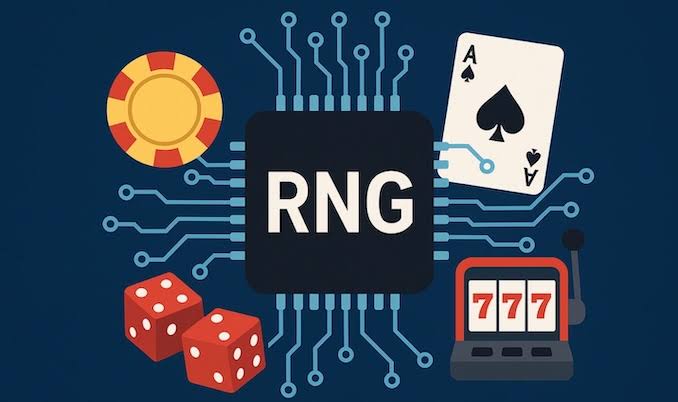
This educational guide explains how Random Number Generators (RNGs) work in online casino games, covering randomness, fairness, independent outcomes, certification, RTP, volatility, common myths, game testing, and responsible gambling. This article is educational only and does not guarantee gambling outcomes or financial returns.
One of the most frequently discussed topics in online casino gaming is the Random Number Generator (RNG).
Whether you’re playing online slots, digital roulette, virtual blackjack, or other computer-based casino games, the RNG is the technology responsible for generating game outcomes.
Despite its importance, many players misunderstand how RNGs work. Myths about “hot machines,” “cold streaks,” or games being “ready to pay” continue to circulate online.
This guide explains how Random Number Generators function, why they are essential to online gaming, and what every player should know in 2026.
What Is an RNG?
A Random Number Generator is a computer algorithm that continuously generates random numerical values.
These numbers determine outcomes in many online casino games, including:
- Slot machines.
- Digital roulette.
- Virtual blackjack.
- Video poker.
- Instant-win games.
- Virtual table games.
The RNG operates continuously—even when nobody is actively playing.
How Does an RNG Work?
An RNG produces thousands of random numbers every second.
When a player presses:
- Spin.
- Deal.
- Play.
- Start.
the system simply selects the number generated at that exact moment.
That number is then translated into the corresponding game outcome.
This entire process happens almost instantly.
Independent Outcomes
One of the most important characteristics of an RNG is that every result is independent.
This means:
- Previous spins do not affect future spins.
- Winning streaks do not make losses more likely.
- Losing streaks do not increase the chance of a future win.
Every game round begins with a new random calculation.
RNG and Slot Machines
In online slots, the RNG determines:
- Symbol positions.
- Bonus triggers.
- Free spins.
- Multipliers.
- Jackpot eligibility.
The visible spinning reels are simply an animation that displays the randomly selected result.
The outcome has already been determined before the animation finishes.
RNG in Digital Table Games
Many virtual table games also use RNG technology.
Examples include:
- Digital roulette.
- Virtual baccarat.
- Electronic blackjack.
- Casino poker variants.
Live dealer games differ because the outcomes are produced by physical cards or roulette wheels operated in real time.
Is RNG Truly Random?
Modern RNG systems are designed to produce outcomes that are statistically unpredictable.
While computer-generated randomness differs from natural randomness in technical terms, certified gaming RNGs are designed to meet strict mathematical standards for fairness and unpredictability.
Independent testing laboratories evaluate these systems before they are approved for use.
Certification and Testing
Reputable gaming software providers typically submit RNG systems for independent verification.
Testing may examine:
- Randomness.
- Statistical distribution.
- Fairness.
- Software integrity.
- Consistency.
Certification helps ensure that outcomes are not intentionally manipulated.
RNG vs RTP
Many players confuse RNG with Return to Player (RTP).
These are different concepts.
RNG
Determines individual game outcomes.
RTP
Represents the theoretical percentage of wagers that a game is mathematically designed to return over an extremely large number of plays.
The RNG creates the random outcomes, while the RTP reflects the long-term mathematical model.
RNG and Volatility
Another concept related to RNG is volatility.
Volatility determines how game returns are distributed over time.
A high-volatility slot may produce:
- Fewer wins.
- Larger potential payouts.
A low-volatility slot may produce:
- More frequent wins.
- Smaller average payouts.
The RNG still determines each individual outcome regardless of the game’s volatility profile.
Common RNG Myths
Myth 1: “The Machine Is Due”
False.
Every spin is independent.
Previous results do not make future results more or less likely.
Myth 2: “Playing Longer Increases the Chance of Winning”
Not necessarily.
Longer sessions simply involve more independent random outcomes.
There is no guaranteed point at which a game becomes more likely to produce a particular result.
Myth 3: “Casinos Can Change Outcomes Whenever They Want”
Licensed gaming systems operate according to certified software.
Reputable operators cannot simply alter individual outcomes at will without compromising certification and regulatory compliance.
Myth 4: “Near Misses Mean a Win Is Coming”
Near misses are simply another randomly generated outcome.
They do not indicate that a future win is approaching.
Why Transparency Matters
Players should look for platforms that clearly publish information about:
- RTP.
- Licensing.
- Responsible gambling.
- Game providers.
- Security measures.
Transparent information helps players better understand how games operate.
RNG and Mobile Gaming
Modern RNG technology functions the same way across devices.
Whether using:
- Desktop computers.
- Android smartphones.
- iPhones.
- Tablets.
the underlying random number generation remains consistent.
Device type does not influence randomness.
Internet Speed and RNG
Some players wonder whether a slower internet connection affects outcomes.
The answer is no.
Connection quality may influence:
- Loading speed.
- Visual animations.
- User experience.
However, it does not change the randomly generated game result.
Artificial Intelligence and RNG
Artificial intelligence is becoming increasingly common in online gaming.
AI may assist with:
- Customer support.
- Fraud detection.
- Personalisation.
- Responsible gambling monitoring.
However, AI does not determine RNG outcomes.
Random game results remain governed by certified mathematical algorithms.
Responsible Gambling
Understanding RNG helps establish realistic expectations.
Because every outcome is random:
- No strategy guarantees success.
- No prediction system can accurately forecast individual results.
- Previous outcomes do not influence future ones.
Responsible gambling includes:
- Setting budgets.
- Taking breaks.
- Avoiding loss chasing.
- Treating gambling as entertainment.
Choosing Games Responsibly
Before trying a new game, players may wish to consider:
- RTP information.
- Volatility.
- Game rules.
- Licensing.
- Responsible gambling features.
Understanding how games operate can contribute to a more informed gaming experience.
The Future of RNG Technology
As online gaming continues to evolve, RNG systems are expected to become:
- More transparent.
- More secure.
- Better audited.
- More efficient.
- Better integrated with modern gaming platforms.
Although technology advances, the fundamental principle remains unchanged:
Every game outcome should remain random and independent.
Conclusion
Random Number Generators are the foundation of modern online casino gaming. They ensure that game outcomes are generated independently and unpredictably, supporting fairness across digital casino games.
Understanding the difference between RNG, RTP, and volatility helps players better understand how casino games actually work and avoid common misconceptions about “hot streaks” or games being “due.”
For anyone exploring online casino entertainment in 2026, learning how RNG technology operates is one of the most valuable steps toward becoming a more informed and responsible player.