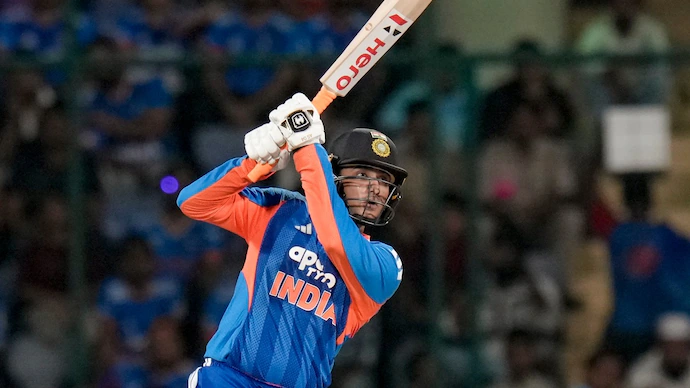
One might easily mistake Abhishek Sharma’s innings against Afghanistan in the third T20I on Thursday for a highlight reel. The stylish opener smashed a 30-ball century at the Arun Jaitley Stadium in New Delhi, hitting nine fours and 10 sixes. It is the quickest by an Indian in T20Is and the fastest globally among players from Test-playing countries. He was merciless yet visually appealing, and once more demonstrated why he enjoys such high praise. He is now the third-fastest to reach a century in T20Is.
He scored 108 off just 34 balls, an innings featuring 9 fours and 11 sixes. Abhishek reached his half-century in just 16 balls and needed only 14 more to hit three figures, but was dismissed in the tenth over, leaving India at 142 for 1. Sanju Samson, the opening batsman, scored 34 runs off 25 balls on the opposite side.
The previous Full Member benchmark of 33 balls was jointly held by Zimbabwe’s Sikandar Raza, who achieved it against Gambia on October 23, 2024, and New Zealand’s Finn Allen, who matched it against South Africa on March 4, 2026. Abhishek’s effort is three balls faster than the shared benchmark.
In the process, Abhishek also broke the India national record. Rohit Sharma had previously achieved that score with a 35-ball century against Sri Lanka in Indore on December 22, 2017. The new record is five balls quicker than Rohit’s performance.
The speed of Abhishek’s innings is further highlighted by the stats: he hit a six every 3.09 balls during his 34-ball stay and accounted for more than 76 per cent of India’s total of 142 for 1 when he was dismissed. This T20I innings ranks among the most damaging ever seen in the format, thanks to the blend of high boundary frequency and complete dominance over a Full Member attack.
He surpassed Rohit Sharma’s record for the fastest T20I century by Indian players, which was set with 35 balls against Sri Lanka in Indore in 2017. Sharma reached his century with a single in the ninth over of India’s innings. This innings marked Abhishek’s third century in the shortest format, adding to his 12 half-centuries. He set two world records: the fastest T20I century by a full-member batter and the highest individual score (76) in men’s T20I Powerplay.